


Need An AI Agent For Your Company?
We will analyze your request and find the optimal AI solution architecture



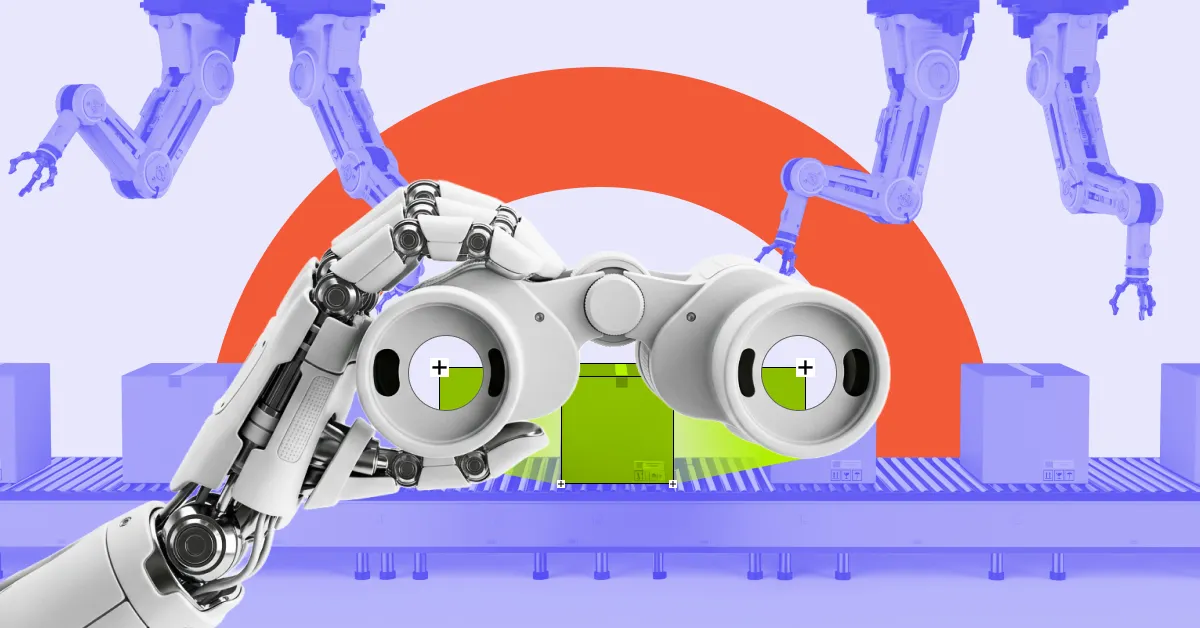
What would cost a company more — a single unplanned production shutdown or a one-time implementation of an AI system? The answer is a production shutdown. In the long run, implementing AI is significantly more cost-effective: it quickly pays for itself and eventually begins to generate profit. For example, studies show that artificial intelligence can reduce factory equipment maintenance costs by up to 40%.
The reason is that production downtime often starts with microscopic errors — the kind that the human eye simply cannot detect. Computer vision helps specialists identify and address these issues before they turn into real problems. Statistics show that, on average, AI-powered visual inspection systems reduce defect detection time in assembly line production by 50–70%.
So how can AI tools help shift manufacturing from a “firefighting” mode to a model of stable, sustainable growth?
In modern research, you will often come across the term Industry 4.0. This refers to the “era of smart manufacturing,” where products and services are built on Big Data, IoT (the Internet of Things), and artificial intelligence technologies. Industry 4.0 is a logical evolution of technology driven by industry demands, as manufacturing typically faces three systemic challenges: increasing quality requirements, a shortage of skilled labor, and the need to reduce downtime. In this context, AI has become critically important because it:
At the same time, AI in large-scale industries is a broad concept that is best understood step by step.
Computer vision is the ability of algorithms to analyze images and video to quickly and efficiently identify patterns, defects, and deviations from the norm.
How it works in practice:
The result of this analysis is a specific action within the production system — from automatic rejection of defective items to adjusting the parameters of the production line.
Unlike manual sampling-based inspection, computer vision systems provide full inspection coverage. The accuracy of defect detection in modern CV solutions can reach up to 99%, which in many scenarios significantly exceeds the quality of human inspection.
So, computer vision has proven its effectiveness in manufacturing — but what exactly does it “see,” and how can it be applied in practice across different industries?
Quality control is one of the most common use cases for computer vision in manufacturing.
In the traditional model, product inspection is often carried out on a sampling basis: an operator examines a portion of items and draws conclusions about the entire batch. This approach only works when production speed is relatively low. AI systems, however, fundamentally change this logic: cameras are installed on the production line and analyze every single unit in real time. As a result, computer vision can:
Another class of solutions focuses not on real-time video streams (as in the previous case), but on capturing images of object conditions and analyzing them over time.
For example, the AI agent SMART StateVision enables condition assessment based on images and comparison with previous photos or a reference state stored in an internal database (for instance, the system can analyze the condition of equipment or vehicles during acceptance and then again after six months of operation).
This functionality makes such agents effective tools for:
An additional advantage of such systems is their integration with business infrastructure. Data on asset condition can be automatically transferred to ERP, EAM, or other enterprise systems, enabling continuous asset analytics.
In addition to direct product inspection, computer vision is widely used for monitoring equipment conditions. Cameras and AI models can analyze the operation of production units and detect deviations in their performance. For example:
The system can automatically flag issues or transmit data to manufacturing management systems. This approach enables a shift from reactive maintenance to predictive maintenance — where potential failures are identified before they lead to unexpected downtime.
Computer vision is also used to automate warehouse operations and monitor product movement.
In this context, CV systems can:
When integrated with ERP and warehouse management systems, this enables real-time visibility into inventory levels. As a result, companies can reduce picking errors, accelerate shipments, and plan supply chains more efficiently.
Another important application of computer vision is improving workplace safety in manufacturing. This is especially critical in industrial environments that involve large and complex machinery, where the speed of response to unexpected situations directly impacts employee safety.
In this context, AI systems become indispensable assistants: they can monitor everything simultaneously, without distraction or fatigue. Computer vision can analyze video streams from surveillance cameras and quickly detect potentially dangerous situations by:
Robotic systems are becoming increasingly common in modern manufacturing. However, for them to operate effectively, they need the ability to navigate their environment and interact with objects — this is where computer vision plays a key role.
With CV systems, robots can:
This technology is particularly important for cobots—robots designed to work alongside humans. Computer vision enables these systems to safely interact with operators and perform precise tasks even in complex manufacturing conditions.

Despite its significant advantages, computer vision is not a fully self-sufficient technology. The effectiveness of such systems depends not only on algorithms, but also on the quality of input data, properly selected hardware, and seamless integration with the company’s existing IT infrastructure.
So, what should be included in your checklist before implementing CV?
The effectiveness of computer vision systems largely depends on the quality of input data. Even the most advanced AI model will not perform reliably if images contain noise, objects are poorly lit, or capture conditions are not properly designed.
That is why, at the preparation stage, it is essential to ensure a stable data capture environment. This includes:
In addition to image quality, it is important to consider the computing infrastructure. Processing video streams in real time often requires high-performance servers or edge devices capable of performing AI analysis directly on the production line.
When selecting cameras and sensors, several key parameters should be factored in:
In some scenarios, not only standard cameras are used, but also specialized sensors — for example, 3D cameras or depth-sensing systems that enable more precise object shape detection. The need for such equipment depends on the specifics of the production process.
For a computer vision system to accurately detect defects or recognize objects, it must be trained on a large dataset. This process typically includes several stages:
Modern systems often rely on deep learning architectures — such as object detection or image segmentation models. These approaches enable high accuracy even in complex manufacturing scenarios.
To deliver maximum value, computer vision must be integrated with other digital systems within the enterprise. This typically involves interaction with:
In this way, when a computer vision system detects a defect, it can automatically send a signal to the production line, create a record in the quality management system, or generate an analytical report for management.
In the automotive industry, computer vision is used not only in manufacturing but also within vehicles themselves. Key use cases include:
In manufacturing processes, computer vision is integrated with IoT sensors, robotic systems, and quality management platforms, helping detect component defects, verify correct assembly, and inspect paintwork quality.
In electronics manufacturing, computer vision is used for automated inspection of printed circuit boards (PCBs) and verification of component placement accuracy.
Due to the extremely small size of components (sometimes around 0.5 mm), computer vision systems are also essential for verifying precise placement. According to a McKinsey study, automated inspection systems can reduce defect rates by 30–50% compared to manual inspection.
In addition, the technology is widely used for SMT inspection (Surface Mount Technology), where components are mounted directly onto printed circuit boards.
In many production lines, computer vision systems are installed on conveyors for automatic product sorting and packaging inspection. These systems are used for:
In metallurgy and mechanical engineering, computer vision is used to control part geometry, detect surface defects, and verify machining accuracy.
These systems often use:
Implementing Computer Vision (CV) involves integrating a completely new technology into a company’s operational ecosystem. The main barriers companies may face during this process can be divided into technical and organizational challenges:
Computer vision technology is evolving from simple object recognition toward deep contextual understanding and predictive analytics. The following key development directions can currently be identified:
SMART business is actively exploring the potential of computer vision. The vendor offers businesses the concept of AI agents — autonomous software modules that not only capture images but also make decisions based on what they see and integrate directly into enterprise systems (ERP, CRM).
The company’s portfolio includes the following solutions:
If you are considering implementing computer vision in your manufacturing processes and are unsure which of the many options to choose, you can submit a consultation request. SMART business experts will help you select and customize a solution tailored to your specific needs.
Yes. AI agents detect microcracks, vibrations, metal discoloration, or lubricant leaks that are invisible to the human eye. This enables issues to be identified before a production line stops, shifting from reactive maintenance (“fix after failure”) to preventive maintenance that avoids potential breakdowns.
A verified dataset is required to launch the system:
It is worth it if:
The project budget consists of three main components: