- EN



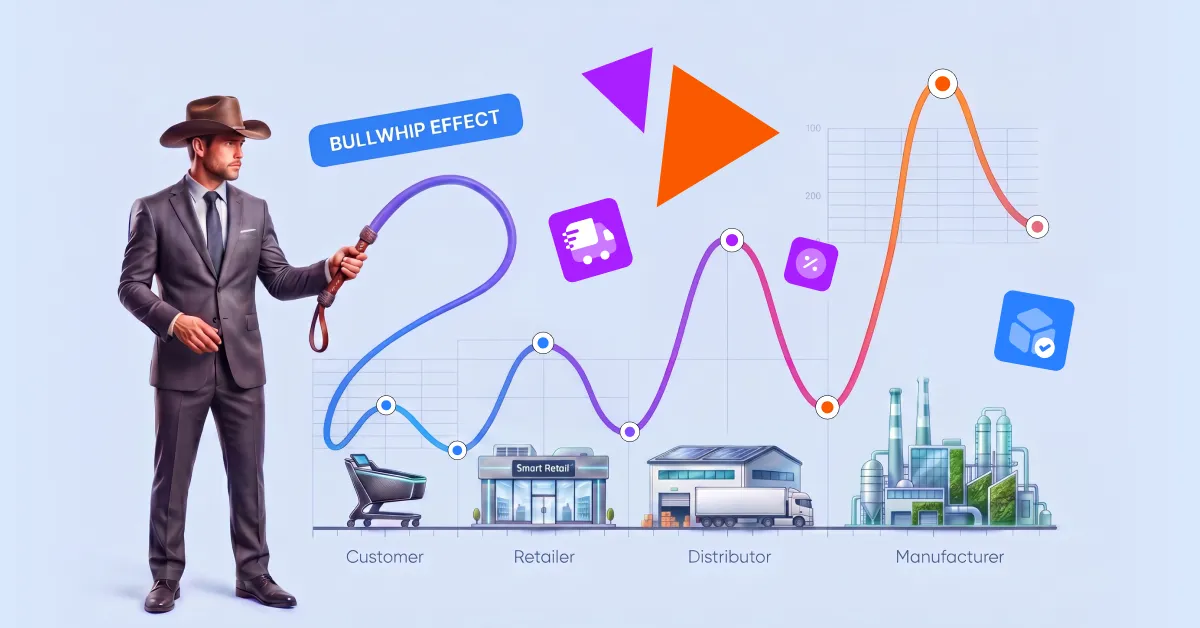
Imagine that sales of a certain product in your retail chain rise by 10%. It seems like a minor change. But the purchasing manager, not wanting to risk a shortage, orders 15% more from the distributor. The distributor hedges too and asks the manufacturer for 20% above the usual volume. The manufacturer buys raw materials with a small safety margin, and the supplier ends up with an order that is already 30% higher than actual demand in the store. None of the participants in the chain really knows what is happening at the final point of sale. Everyone is simply playing it safe. When sales return to normal, the entire chain grinds to a halt: warehouses are overflowing and new orders are cut back. This is where the "bullwhip effect" kicks in.
The bullwhip effect is a phenomenon whose name says it all. Just as a whip flicked gently at the handle delivers a sharp crack at the tip, a small change in end-customer demand turns into powerful swings along the supply chain: from the retailer to the distributor, from the distributor to the manufacturer, from the manufacturer to the raw-material supplier. The farther a link is from the end customer, the harder the "crack of the whip" it feels. Jay Forrester was the first to describe the phenomenon systematically, in the 1960s, which is why it is also known in academic circles as the Forrester effect.
This is not a theoretical threat but an operational reality that businesses feel in their costs and lost profits. The true scale of the problem becomes even clearer in post-pandemic data: manufacturing plants that ran at full capacity in 2021 were using only 60–70% of their maximum capacity in 2023, a direct illustration of how uneven demand hits the entire chain.
The instability hasn't gone anywhere. A McKinsey survey of chief procurement officers showed that 73% of them see demand volatility as one of the key challenges for supplier relationships over the next five years. Meanwhile, Gartner research found that 73% of companies have already revised the structure of their supply chains over the past two years, with risk management and greater resilience as the main motivation.
So why does the bullwhip effect arise even in mature companies with experienced teams? And which approaches can actually help tame it? Let's take it step by step.
The bullwhip effect rarely has a single cause. Usually it is a combination of several systemic problems, each of which seems minor on its own, but together they turn the supply chain into a zone of unpredictability. And the longer the chain, the more the fluctuations are amplified.
What makes this especially dangerous is that each participant in the chain sees only its own part of the picture. The retailer looks at sales, the distributor at the retailer's orders, the manufacturer at the distributor's requests, and the raw-material supplier at production plans. As a result, real demand signals get distorted at every stage.
Let's look at the main causes of the bullwhip effect that most often create imbalances in supply chains.
One of the most common reasons for the bullwhip effect is inaccurate demand forecasting and overreaction to short-term market changes. The problem arises both when a business overestimates future demand and when it underestimates it.
For example, after several weeks of high sales, a company may decide that demand will keep growing, so it increases purchasing, production, and safety stock. But it works the other way too: if a business mistakes a temporary dip in sales for a long-term trend, it sharply cuts orders and inventory. As a result, when demand recovers, the supply chain simply can't respond fast enough.
That is why stock shortages and surpluses are often two extremes of the same process. In both cases the problem starts with distorted demand signals, which only get stronger as they travel up the supply chain. From a supply chain management perspective, even a small deviation in forecasts can cause disproportionately large consequences for the business. A few extra or missing percentage points in demand forecasting can set off a whole chain of additional costs, from overloaded warehouses and urgent purchases to chaotic production rescheduling and rising logistics costs.
This is especially noticeable in companies where demand forecasting is built mainly on historical data, without accounting for seasonality, market context, customer behavior, or current operational data.
In many companies, orders are not placed continuously but in large batches, for example once a week or once a month. This helps optimize logistics and reduce transportation costs, but at the same time it creates unevenness across the whole chain.
As a result, suppliers see not steady demand but sharp spikes in orders: almost nothing today, a large volume tomorrow. This makes it harder to plan production, purchasing, and inventory management.
The effect is especially pronounced in the B2B segment and in industrial supply chains, where shipments can be very large and lead times very long.
Another cause of the bullwhip effect is aggressive promotions, temporary discounts, and price instability. A discount, a promotion, a special offer, and retailers immediately stock up on far more than they need right now. The supplier sees a jump in demand and ramps up production. But once the promotion ends, demand can drop sharply. The manufacturer is left with a surplus, and the retailer with an overfilled warehouse. That is why, in supply chain management, excessive dependence on promotions and price incentives often leads to excess inventory and unstable supply. This kind of price volatility is one of the most common triggers of the bullwhip effect, especially in consumer goods and FMCG.
In many supply chains, data on sales, inventory, or changes in demand arrives late. Some information is passed on manually, some through different systems, and sometimes partners in the chain have no access to each other's current data at all. The manufacturer learns about a change in demand several weeks late. By then it has already made raw-material purchasing decisions, launched production plans, and allocated capacity. A late signal means a late response, and that means excess inventory or shortages.
In such an environment, each participant often operates in an information vacuum. Instead of working with real demand data, companies rely on their own assumptions or outdated reports.
The longer the lead time, the bigger the "uncertainty buffer" each link builds in. If a supplier fulfills orders in eight weeks, the buyer has to forecast demand two months ahead, which significantly raises the risk of error. Long delays force companies to order more, and earlier, than they really need, which automatically amplifies order fluctuations across the entire supply chain.
Imagine this situation: a certain product is in short supply on the market. The supplier can't satisfy everyone and starts dividing the available volume among buyers, so the more you order, the more you get. Buyers quickly catch on and act accordingly: "I'll order twice as much as I need, so I'll at least get what I actually need." Everyone does this at the same time. The supplier sees a sharp rise in orders and takes it for real demand, so it ramps up production, buys raw materials, and loads capacity. And when the shortage passes and buyers stop padding their orders, orders collapse. The manufacturer is left with overflowing warehouses and idle production lines.
This is exactly what happened during the global semiconductor shortage of 2021–2022. The chip shortage prompted companies to order 10–20% more than they really needed, building a safety buffer in case part of the order went unfulfilled. In the automotive industry alone, in 2022 manufacturers and tier-one suppliers placed orders for enough volume to produce 120 million vehicles, while actual sales were forecast at 83 million. A classic shortage gaming trap in action.
The consequences of the bullwhip effect rarely show up all at once. Usually they unfold like dominoes: one problem drags in the next, and the company ends up putting out fires on several fronts at the same time.
When demand fluctuations start to "whip up" the supply chain, the problem stops being just a forecasting issue. It quickly moves into the realm of operational efficiency: warehouses, production, logistics, and even customer service begin to work in a state of constant imbalance. This imbalance has a number of specific manifestations that gradually pile on top of each other and create a domino effect. Below are the key consequences that companies most often face under the influence of the bullwhip effect.
So in the long run, even small disruptions in the supply chain can lead to a loss of market position if the company does not control demand fluctuations at the level of the whole system.

One of the main problems with the bullwhip effect is that companies often notice it too late, when warehouses are already overflowing, production is in a mode of constant changeovers, and teams are trying to fight shortages of some products and get rid of surpluses of others at the same time.
Yet the bullwhip effect almost never appears suddenly. In most cases the system starts giving signals much earlier. The question is whether the business sees them and has enough data transparency across the supply chain.
So to avoid reaching the critical moment, it is worth watching the early indicators closely. They are the first to signal that the bullwhip effect is starting to work against the company.
In practice, businesses often notice the problem only through its indirect consequences: more urgent purchases, chaotic production rescheduling, conflicts with suppliers, a growing number of "emergency" logistics decisions, or constantly shifting priorities within teams. And although on the surface these look like separate operational difficulties, in reality they may be part of a single systemic phenomenon in supply chain management.
That is why modern supply chain management is increasingly shifting toward data transparency, real-time analytics, and synchronization among all participants in the chain. After all, the earlier a company sees the distortion of demand signals, the better its chances of stopping the bullwhip effect before it begins to have a large-scale impact on inventory, costs, and service levels.
The bullwhip effect cannot be eliminated completely: demand fluctuations have always been, and will remain, part of the market. But a business can significantly reduce their impact if it learns to spot changes faster, forecast demand more accurately, and synchronize the actions of all supply chain participants.
The problem is that traditional planning approaches often simply can't keep up with the modern pace of change. When forecasts are built manually in spreadsheets, data is updated with a delay, and every department works within its own frame of reference, fluctuations only accumulate. That is why supply chain management is increasingly moving toward AI-driven planning: systems that work with real-time data, automatically detect anomalies, and help a business react before a problem becomes critical.
One of the most effective ways of bullwhip effect mitigation is improving the accuracy of demand forecasting. The better a business understands real consumer demand, the less need there is to build excess safety stock or sharply change order volumes.
This is where artificial intelligence plays a growing role. AI and ML models can analyze far more factors than classic forecasting approaches: seasonality, promotions, customer behavior, historical sales, regional specifics, external market changes, and even hidden patterns that are hard to spot manually.
For example, the SMART Demand Forecast system from SMART business uses AI and ML algorithms to forecast regular and promo sales, helping businesses determine the required inventory level more accurately and reduce the risk of overstock or out-of-stock situations. The system takes into account not only historical data but also the demand context, the specifics of individual SKUs, and customer behavior patterns.
It is especially important that modern AI solutions don't just generate a forecast but also assess its quality. If the model sees unusual demand behavior or a sharp deviation from typical scenarios, the system can automatically flag a potential risk before the fluctuations start to scale up the supply chain.
The bullwhip effect is often amplified not by the demand changes themselves but by communication delays between supply chain participants. While information passes through several levels (retailer, distributor, manufacturer, supplier), it loses relevance, gets distorted, or arrives too late.
The simplest and at the same time most effective step is to open access to real sales and inventory data for key partners in the chain. When a distributor sees not only its own order but also real demand at the points of sale, it stops overinsuring. The same applies to the manufacturer and the supplier.
That is why data transparency and shared process visibility have become some of the key strategies in modern supply chain management. When a business works with up-to-date data on sales, inventory, promotions, and demand signals in real time, the need to "play it safe" drops significantly.
Systems like SMART Demand Forecast make it possible to work with analytics, sales history, and forecast quality centrally through integrated Power BI tools. Supply chain teams can quickly see where exactly anomalies arise, which factors influence demand the most, and how the situation is changing across the whole chain.
As a result, the company moves from a reactive management model, where decisions are made after a problem appears, to a proactive one, where the business can adapt to changes before they lead to shortages or excess inventory.
Another critically important factor in reducing the bullwhip effect is stabilizing the ordering and inventory replenishment process. The less often a company makes large purchases "just in case", the fewer fluctuations it creates for everyone else in the chain.
That is why modern planning systems increasingly shift to a model of smaller but more frequent orders with dynamic adjustment based on current demand data. This shrinks the uncertainty buffer and reduces safety stock while maintaining a high level of product availability. Yes, it requires revisiting logistics processes and terms with suppliers, but the result is tangible: instead of sharp order spikes, the supplier receives an even, predictable signal.
Here AI helps not only to forecast demand but also to optimize the replenishment process itself. For example, SMART Demand Forecast lets you model different sales and promotion scenarios, analyze the potential impact of marketing campaigns, and quickly adapt purchasing plans to new conditions.
Automatic anomaly handling plays a separate role. If the system detects an atypical spike or drop in demand, AI can smooth out these deviations so that random fluctuations don't trigger a new wave of chaos across the supply chain.
In the end, the business gets a mechanism for stabilizing the entire supply chain: with fewer losses, more accurate decisions, and a much lower level of operational turbulence.
SMART Demand Forecast from SMART business is built on exactly these principles. The solution combines machine learning and AI algorithms for accurate forecasting of regular and promo sales, automatic detection and smoothing of anomalies in the data, scenario modeling with different promo conditions, and powerful Power BI–based analytics for fast decision-making.
For companies facing the bullwhip effect, implementing this solution means concrete results: less money tied up in inventory, fewer sales lost to shortages, and a supply chain team that can finally focus on strategy rather than daily firefighting.
The bullwhip effect is a systemic phenomenon in supply chain management that can gradually throw the entire operating model of a business out of balance, from purchasing and production to logistics, inventory, and customer service levels.
The good news is that the bullwhip effect is not a death sentence. It is easy to diagnose, has clear causes, and, most importantly, can be managed systematically. A combination of data transparency, sound planning, and modern AI tools lets you do more than react to demand fluctuations. You can anticipate them, spot anomalies faster, forecast sales more accurately, optimize inventory management, and maintain stability even in periods of high uncertainty.
If you notice that the bullwhip effect is already starting to affect your supply chain, or you want to prevent operational chaos in the future, book a consultation with SMART business. The team will help you analyze your current processes, find weak points in demand forecasting, and choose an AI solution that helps stabilize supply, reduce excess inventory, and improve the accuracy of management decisions.

