- EN



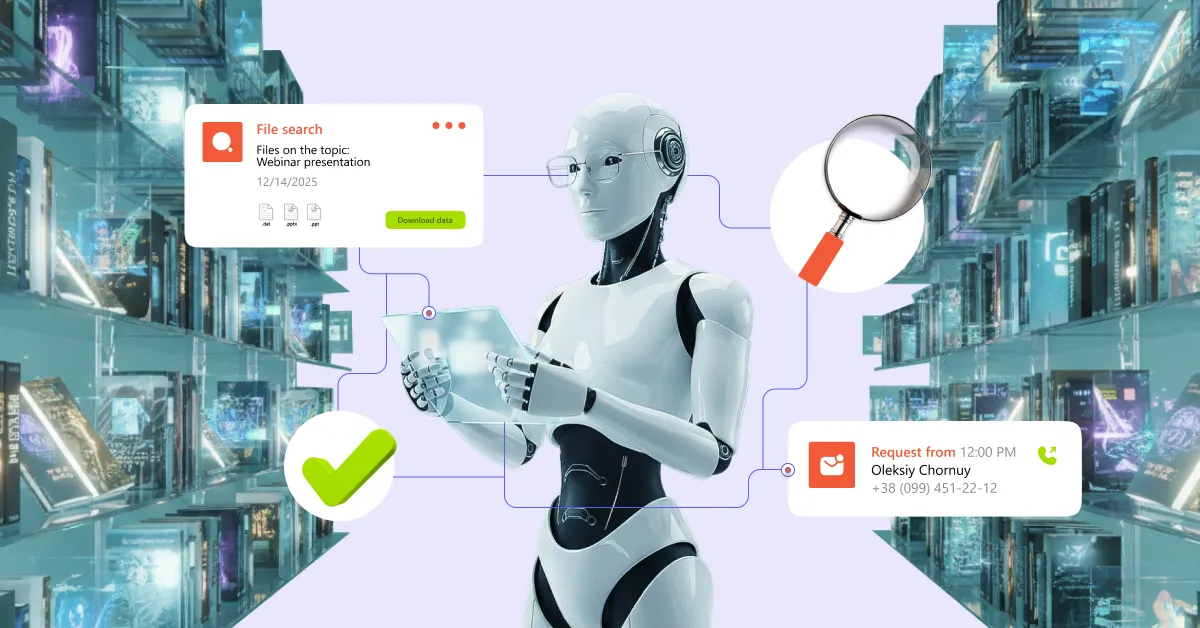
Public AI models are often characterized by a phenomenon known as “hallucinations.” This occurs when a model generates responses based not on verified facts but on generalized or incomplete knowledge from its training data. As a result, basic AI can be excellent at producing well-written text yet unreliable when it comes to factual accuracy. While this may not be critical for everyday tasks, in a business environment such errors can lead to confusion, inaccurate reporting, or even financial losses.
This is why AI tools that not only respond quickly but also understand internal documentation are gaining popularity in the business world — their adoption rate increased from 31% to 51% in 2024 alone. These AI models are known as RAG (Retrieval-Augmented Generation).
RAG can be thought of as a “researcher + analyst + writer” in the AI world. Before generating a response, the system first retrieves relevant information from internal sources (including CRM and ERP systems) and only then formulates an answer grounded in verified data. This approach creates a flexible, context-aware, and reliable tool for businesses. Here is how it works step by step:
Traditional chatbots operate on the principle of “knowing what they were trained on.” They respond based on predefined scenarios or the model’s general knowledge, which often makes them sound similar across organizations. When users ask questions that fall outside established rules or training data, these bots tend to struggle — inventing facts, offering inaccurate guidance, or relying on generic statements. For businesses, such tools provide limited value: they lack awareness of internal processes, have no access to corporate policies, and cannot interpret data within a meaningful organizational context.
RAG agents take a fundamentally different approach. Instead of “guessing” an answer, they generate responses using current, relevant information. Before replying, the agent consults specific internal sources — CRM records, ERP data, knowledge bases, policies, quality standards, or even internal communications. In this sense, a RAG agent behaves less like a chatbot and more like an employee who locates the right document first and then explains it in clear, human language.
A RAG agent is a micro-ecosystem that combines retrieval, analysis, and generation into a unified workflow. Its effectiveness relies on three core elements: high-quality data retrieval, precise content generation, and deep integration with corporate systems.
Integrating RAG agents with corporate systems means creating a unified intelligent ecosystem that becomes part of a company’s overall architecture. A well-integrated RAG agent adapts to established workflows and begins operating like a central intelligence layer — reading and interpreting information from numerous internal sources.
1. CRM integration: personalized responses and automated customer engagement
Within CRM systems, a RAG agent analyzes customer interaction history, deal statuses, support requests, and manager notes. Based on this data, it can:
2. ERP integration: contextual insights and operational guidance
ERP is a complex environment with multiple modules, including finance, logistics, inventory, and procurement. A RAG agent integrates via APIs to gain real-time access to data, enabling it to:
3. HRM and HR portals: instant answers and faster employee onboarding
In HR systems, a RAG agent often becomes the first point of contact between employees and the organization. It can:
Today, RAG systems are most commonly used for three types of tasks: media and content generation, personalized recommendations, and response generation for so-called “conversational agents.” When working with content, an agent can produce explanations, training materials, technical documentation, or analytics by leveraging access to internal knowledge bases, case libraries, and reference materials.
These RAG agents are reshaping how organizations work with information, offering the following advantages:
RAG agents shorten the path from query to response from hours to seconds. With access to up-to-date documents, CRM and ERP data, and internal policies, the system delivers verified information drawn directly from corporate sources. This minimizes errors, reduces the need for follow-up clarification, and ensures consistently high-quality responses — regardless of workload or human factors.
Automating routine inquiries reduces the burden on support services as well as HR, finance, and IT teams. RAG agents handle answers to common questions, explain processes, guide users through documentation, and prepare initial information. As a result, organizations save the time of highly skilled specialists and reduce costs without compromising service quality.
Unlike traditional chatbots, RAG operates within the business context — taking into account the user’s role, access permissions, and history of interaction with corporate systems. This enables the delivery of personalized, relevant responses, from step-by-step guidance for new employees to analytical explanations for executives. The organization benefits from a consistent interpretation of rules and data, eliminating informational “silos” between departments.
RAG agents scale effortlessly alongside the business: as the volume of documents, employees, or customers grows, response quality remains consistent. New knowledge is incorporated through indexing rather than model retraining, making system expansion faster, more controlled, and more predictable in terms of cost.
When integrated with CRM, ERP, and HRM platforms, RAG agents can generate responses based on live data — including deal statuses, financial metrics, workforce changes, and current policies. This transforms them from a reference tool into an active partner in both operational and managerial decision-making.
In practice, the functionality of RAG agents can be applied across nearly every industry — from delivery services to recruitment platforms. In customer support, RAG agents are gradually replacing traditional FAQ bots, which operate on scripted scenarios and often fail when faced with unexpected questions. Instead, a RAG agent integrates with CRM systems, support ticket databases, technical documentation, and customer interaction histories — generating responses that take real-world context into account. Here’s how this works in practice:
Recruitment platform LinkedIn reduced the average time to resolve support issues by 28.6% by combining RAG agent functionality with a knowledge graph (a method for transforming unstructured data into a network of meaningful relationships).
Rather than analyzing support histories and issues as one large block of text, the solution builds a knowledge graph that captures the internal structure of each issue and the relationships between them. When a user submits a query, the RAG system analyzes its content and retrieves relevant subgraphs from the knowledge model — meaning the user receives only the information that directly answers their question, without unnecessary “noise.” These contexts are then used to generate the response. This approach reduces the negative effects of fragmented documentation and significantly improves both search accuracy and the quality of answers.
Telecommunications company Bell leveraged RAG to modernize its internal knowledge management system and provide employees with access to up-to-date policies and guidelines. As part of this approach, the company built a dedicated knowledge management component that operates within the RAG architecture.
Bell implemented modular pipelines to process and vectorize documents from various sources — both in batch mode and with real-time updates. The system automatically reindexes data whenever documents are added, modified, or removed, ensuring the knowledge base remains current. Each component of the solution is treated as an independent service, and its development and maintenance follow DevOps principles — making the system scalable, transparent, and user-friendly.
Visual search platform Pinterest applied a RAG agent to simplify internal teams’ work with analytical data. Its goal is to help employees formulate SQL queries without deep knowledge of the underlying data structures. The initial implementation was straightforward: the user asked a question, manually selected tables, and the system passed this information to an LLM to generate the SQL. While functional, choosing the correct tables proved to be a complex and time-consuming step.
To reduce this burden on users, Pinterest integrated a RAG mechanism. The system creates a vector index of table descriptions, converts the user’s query into a vector, and performs a semantic search. First, it identifies the most relevant tables, after which the LLM further selects the optimal subset for the specific query. Only then is the SQL query generated and the final answer produced. As a result, users receive accurate analytical queries without needing to understand the complex underlying data structure.
Before anything else, start by clearly defining your business scenario: determine exactly what you need the RAG agent for — for example, internal document search, customer support, compliance and policy management, analytics, or employee assistance in CRM/ERP. The same RAG approach can work very differently depending on the task: an HR assistant has different requirements for accuracy, access, and speed than, for example, a support desk agent.
Implementing RAG methodologies is not simply about building a “layer” on top of a standard corporate chatbot. The effectiveness of a deployed agent directly depends on how well an organization manages its content, IT infrastructure, and internal processes.
The key challenges in implementing RAG agents are typically data quality and relevance (outdated or conflicting documents immediately reduce the accuracy of responses), access control and security (RAG should only be able to access data that the user is authorized to view), and integration complexity (connecting various CRMs, ERPs, and data stores with their own APIs and logic).
To address these challenges, each company naturally customizes the agent to meet its specific needs. However, there are a few best practices that can significantly improve the output quality of any RAG agent:
Step 1: Building and Structuring a Knowledge Base
A RAG agent works with the data it is given — if documents are outdated, unstructured, or scattered across multiple systems, the agent will provide poor answers. Therefore, before deployment, it’s recommended to:
A company doesn’t necessarily have to do all of this itself — an experienced vendor managing the deployment will often handle the creation of such a knowledge base.
Step 2: Architecture and Technical Integration — Modularity and Scalability
For stable RAG operation in an organization, especially a large one, it’s advisable to build a modular rather than monolithic architecture. This allows individual components (retriever, vector database, LLM, etc.) to be replaced or updated without overhauling all processes. Key considerations include:
Step 3: Security, Access Control, and Data Compliance
When an agent works with corporate or sensitive data — such as policies, contracts, or personal information — establishing proper security and access control policies is critical. Key measures include:
Step 4: Pilot and Gradual Scaling
To avoid risking workflow stability, it’s advisable to start with a pilot — select one small but important business task (onboarding, support, internal search), deploy RAG on a minimal scale, and measure the results. If the pilot demonstrates potential, gradually scale by adding new data sources, user groups, scenarios, and so on. At the same time, define how effectiveness will be measured.
Step 5: User Training, Corporate Culture, and Human Responsibility
RAG is not a perfect tool. Even the best system can produce inaccuracies or require fine-tuning. Therefore, it is important to:
The key direction for RAG agents is deeper integration with corporate systems. Increasingly, RAG will work not only with documents but also with live data from CRM, ERP, HRM, and BI platforms — including transactions, process statuses, and user roles. This will soon make RAG a fully contextual digital assistant that understands what is happening in the company in real time and can act according to business logic and access policies.
Another important trend is the growing demand for trust and governability in RAG agents. In regulated industries — such as finance, healthcare, energy, and the public sector — RAG will evolve toward clear traceability of sources, version control of knowledge, detailed explanations, and compliance with standards like GDPR.
However, it’s important to understand that RAG will not replace humans. This AI model enhances human capabilities: it helps users navigate complex data sets more quickly, responds to repetitive queries, highlights subtle details, and provides a foundation for informed decisions. It is a tool that allows employees to focus fully on high-value tasks rather than on routine information retrieval.
SMART business approaches RAG implementation as an engineered business solution, designed to seamlessly fit into a company’s digital ecosystem. The company designs RAG solutions based on the Microsoft Copilot RAG stack (Azure OpenAI, Azure AI Search, Power Platform, etc.), integrating agents into CRM, ERP, HRM, corporate portals, and knowledge bases. This enables the creation of agents that work with real company data — contracts, policies, customer histories, financial and operational processes — while respecting access roles and security requirements.
SMART business provides a full implementation cycle: from data auditing and knowledge base preparation to RAG pipeline architecture, retrieval logic optimization, quality metric setup, and team training. The company helps businesses select the right use case (internal knowledge assistant, customer support, compliance agent, analytics assistant, etc.) and ensures the solution is scalable.
Ready to turn a RAG agent into your personal business tool? Submit a request, and the SMART business team will help you design and deploy a secure, scalable RAG solution based on Microsoft technology.
There is no universal answer — the best RAG always depends on the company’s context. For organizations already operating within the Microsoft ecosystem, solutions based on Azure OpenAI + Azure AI Search + Microsoft Fabric/SharePoint/Dynamics 365 are usually the optimal choice. They provide deep integration with ERP, CRM, and HRM, high security, and compliance with corporate policies. For other scenarios, open-source stacks or hybrid architectures may be suitable — the key is not the tool itself, but a properly designed RAG architecture.
Costs depend on scale and complexity: the number of data sources, volume of documents, security requirements, and integrations. Typically, expenses fall into three categories:
According to market estimates, small RAG MVP projects can start at around $5,000–$20,000 for basic functionality and a limited set of documents. Advanced enterprise solutions often range from $40,000–$100,000 or more, depending on complexity, integrations, and automation requirements.
An LLM (Large Language Model) is a language model that generates responses based on knowledge acquired during training. It formulates text well but does not have access to up-to-date or internal company data.
RAG adds a retrieval step: before generating a response, the model consults corporate documents, CRM, ERP, or knowledge bases. As a result, a RAG agent answers based on verified and relevant sources, significantly reducing the risk of hallucinations.
Yes, in certain scenarios ChatGPT employs RAG-like mechanisms — for example, when accessing external tools, files, or search. However, in a business context, the key difference is that a corporate RAG agent works with your internal data in a controlled environment, with clear rules for access, security, and regulatory compliance. This is what makes RAG critical for ERP, CRM, and corporate knowledge systems.

