- EN



Gartner predicted that more than 80% of enterprises would be using generative AI by 2026 — and that prediction is proving accurate. While the share of such companies did not exceed 5% in 2023, the pace of adoption has turned out to be one of the fastest seen in recent decades.
In this article, we’ll explore how generative AI works, what it can create, where it is already proving effective, and what risks to consider before implementing it.
Generative AI is a type of AI that does not simply analyze or classify existing information but creates new content: text, images, audio, video, and software code. It learns from large datasets, identifies patterns and relationships within them, and then uses this knowledge to generate outputs.
Unlike traditional systems for searching and processing information, generative AI works in a fundamentally different way: it does not simply find a ready-made answer in a database but creates new content based on the context it has learned. That is why it is called generative — it creates rather than simply processes information.
To understand how this technology works, it is worth knowing a few basic concepts.
GenAI is short for Generative AI and is a general term for the entire class of generative artificial intelligence models.
Generative model is a machine learning algorithm trained on large datasets. The model itself “learns” to understand language, images, or code and reproduces them in new combinations. Large language models — such as those powering Copilot, ChatGPT, or Google Gemini — are among the most common types of generative models.
Prompt is a query or instruction that a user provides to a system. The accuracy and clarity of a prompt largely determine the quality of the response. That is why the ability to work with prompts is becoming a practical skill in its own right for teams using generative AI-powered tools.
There are different approaches to artificial intelligence. Traditional AI models focus on data analysis, classification, and prediction, while generative AI has a different goal — creating new content based on learned patterns. Understanding this difference helps determine where traditional methods are sufficient and where generative AI can deliver the most value.
| Criterion | Traditional AI | Generative AI |
| Goal | Analysis, classification, prediction | Creating new content |
| Input data | Structured datasets | Large volumes of diverse data |
| Output | Category, number, decision | Text, images, audio, code |
| Example | Detecting fraudulent transactions | Generating marketing copy |
Traditional machine learning performs well on clearly defined tasks such as recognizing objects in photos, predicting customer churn, or recommending products. But if you need to write an email, generate a product image, or create packaging design concepts, this is where generative AI comes into play. It does not simply select an answer from a knowledge base; it creates one tailored to the specific context and needs of the user.
It is this ability to create new content that makes generative models so relevant to businesses: they automate not only routine operations but also creative and knowledge-intensive tasks that previously required exclusively human involvement.
Despite the complexity of the algorithms involved, how generative AI works can be explained in a few sequential steps. A model does not store ready-made answers to every possible question. Instead, it is trained on large datasets, identifies patterns between words, images, code snippets, or other types of information, and then uses this knowledge to create a new output.
In simplified terms, the way generative AI works can be broken down into the following steps:
It is important to understand that generative AI does not “think” the way humans do. It does not fact-check information in real time or understand it in the human sense. A model works with statistical patterns learned during training and generates the response that is most likely to fit a particular query. This allows it to create original content, but it also means that it can sometimes produce inaccuracies or so-called hallucinations.
Today, there are several types of generative AI models. They are based on different machine learning approaches and are used for different tasks. Below are the most common generative AI models and their applications.
Large Language Models (LLMs) are the most widely used type of generative AI today. They are built on the transformer architecture, a type of neural network that can analyze large volumes of text, account for the context between words, and generate coherent responses.
LLMs power ChatGPT, Microsoft Copilot, and Google Gemini. They are used for content creation, document preparation, programming, information retrieval, text analysis, and chatbot applications.
GANs consist of two neural networks that work together. One network generates new data, while the other evaluates how closely it resembles real data. This approach allows the model to gradually improve the quality of its outputs.
GANs are most commonly used to generate realistic images, create AI-generated photos of people or objects, enhance graphics, and prepare training datasets for other AI systems.
VAEs are generative models that learn to identify underlying patterns in data and create new variations with similar characteristics.
These models are used in research, product design, data modeling, and the creation of new design concepts. For example, they can help generate product concepts or model scenarios for machine learning.
Diffusion models create images gradually. The model starts with random noise and then, step by step, turns it into a detailed image based on the user's prompt.
This approach is used by many modern AI tools to generate illustrations, advertising materials, concept art, and product visualizations. Diffusion models are also used to edit existing images and create multiple design variations.
Today, LLMs have become the most widely adopted type of generative AI model because they support a broad range of business tasks — from content creation and knowledge work automation to programming, document analysis, and natural-language customer interactions. At the same time, other types of models remain essential in areas that require image generation, data modeling, or the development of new design solutions.
The capabilities of generative AI go far beyond writing text or creating chatbots. Modern models can generate different types of content — from images and software code to music and synthetic data. This allows companies to automate certain creative and knowledge-intensive tasks, test ideas faster, and support employees across various business processes.
| Content type | Example task | Potential business application |
| Text | Writing an article, email, or product description, or preparing a document summary | Marketing, sales, technical documentation, internal corporate communications |
| Images | Creating illustrations, advertising banners, or product concepts | Marketing, design, branding, e-commerce |
| Audio | Generating voice-overs, synthesizing speech, or creating voice messages | Contact centers, training materials, digital assistants |
| Music | Creating musical compositions or background music | Advertising, video production, multimedia content |
| Video | Generating short videos, animations, or presentations | Marketing, employee training, corporate communications |
| Software code | Writing code, creating SQL queries, explaining algorithms, or debugging | Software development, programming automation, testing |
| Synthetic data | Creating artificial datasets that reproduce the characteristics of real data without using confidential information | Training AI models, system testing, analytics |
At the same time, it is important to understand that generative AI does not guarantee error-free results. Whether a model generates text, images, software code, or other content, the output requires human review. This is especially important for materials that influence business decisions, involve customer interactions, or contain confidential information.
That is why most companies use generative AI not as a complete replacement for specialists but as a tool that helps them complete routine and creative tasks faster, while keeping control and final decision-making in human hands.
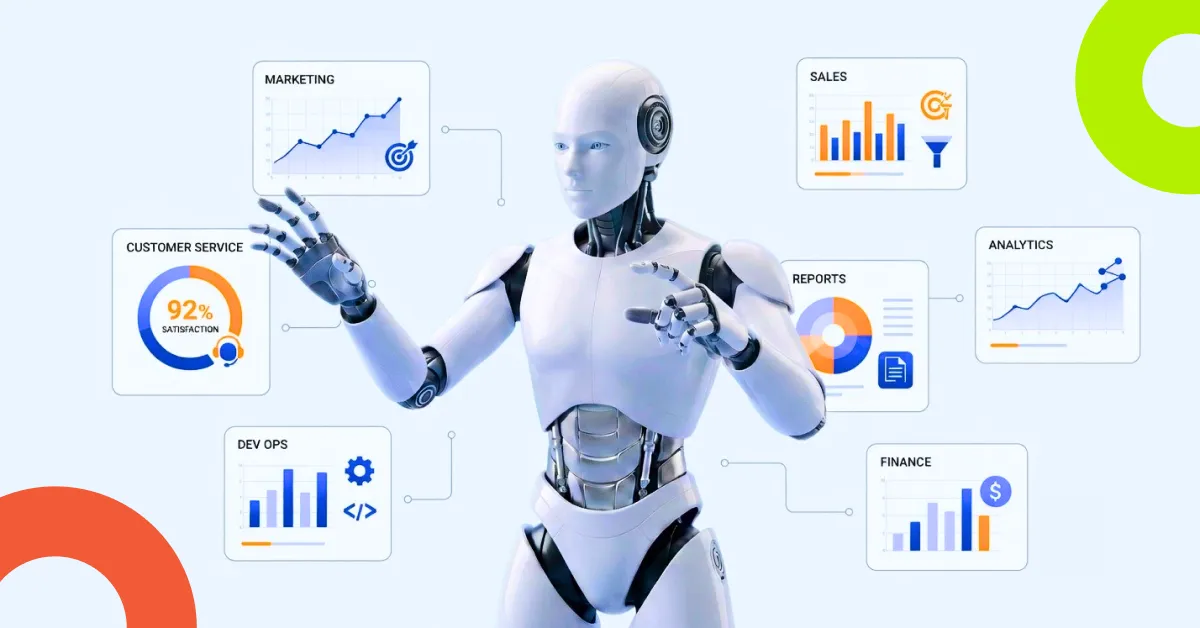
Generative AI is already being used across a wide range of industries, from marketing and software development to finance, HR, and healthcare. In some cases, it helps create content faster; in others, it analyzes large volumes of information, prepares documents, or supports decision-making. Below, we’ll look at the most common applications of generative AI in business.
Marketing was one of the first areas where generative AI became widely used in day-to-day work. It helps create different versions of text, images, and advertising materials that employees can refine to meet brand requirements.
For example, AI tools are used to write articles, product descriptions, emails, social media posts, advertisements, and video scripts. Generative AI can also create illustrations, banners, design concepts, and multiple versions of marketing campaigns for different audiences.
This approach helps reduce the time needed to prepare content, test new ideas faster, and personalize customer communications.
In sales, generative AI helps prepare personalized sales proposals, respond to common customer inquiries, and generate recommendations for sales managers.
Based on information from CRM systems, a model can draft an email to a potential customer, summarize interaction history, suggest the next sales step, or create a brief summary of negotiations. Chatbots powered by large language models can answer customer questions in natural language and operate around the clock.
As a result, managers spend less time on routine document preparation and can focus more on working with customers.
Developers use generative AI as an assistant when writing software code. It can generate code snippets, explain algorithms, suggest ways to implement functions, identify potential errors, and help write documentation.
In addition, AI tools can automatically generate SQL queries, test scenarios, regular expressions, and examples of API (Application Programming Interface) usage. This is particularly useful for speeding up routine stages of software development.
At the same time, developers should perform the final review of architectural decisions, security, and code quality, as a model may suggest an inefficient or incorrect solution.
In finance departments, generative AI helps work with large volumes of information, prepare reports, and explain analytical results in clear language.
For example, it can summarize financial metrics, generate written explanations for reports, analyze contracts, answer questions about corporate documentation, or help find relevant information among large numbers of documents.
These tools do not replace finance professionals but reduce the time spent on reporting and working with a company's internal data.
HR teams use generative AI to automate many day-to-day tasks. It can help create job descriptions, develop interview questions, summarize candidate resumes, and prepare onboarding materials for new employees.
In administrative work, generative AI can create meeting minutes, draft internal guidelines, prepare document templates, and answer common employee questions based on the company's knowledge base.
This allows employees to spend more time on work that requires expert judgment and human interaction.
In scientific research, generative AI helps analyze large volumes of academic publications, identify relationships between data, and speed up the preparation of research materials.
In healthcare, it is used to prepare drafts of medical documentation, analyze clinical information, and support physicians when working with large datasets. At the same time, final clinical decisions are always made by a medical professional.
In product design, generative AI helps quickly create product concepts, packaging options, interfaces, or industrial design concepts. This allows teams to test different ideas faster, even before creating a physical prototype.
Generative AI delivers the most value when it complements employees’ work and reduces the time spent on repetitive tasks. Below are the main benefits that companies across various industries are already gaining.
Despite the rapid development of AI, modern models can make mistakes, reproduce biases from their training data, or generate content that requires additional review. This is particularly relevant to publicly available generative AI services that rely on open or general datasets and do not have access to a company's internal context. Using such tools also raises concerns about protecting confidential information, copyright, and the transparency of how models operate. Understanding these risks helps businesses establish rules for safe AI use and get the most value from the technology.
Let's look at the key risks.
Generative AI can produce convincing responses that contain factual errors or fabricated information. This phenomenon is known as hallucination. Hallucinations can be particularly dangerous when working with financial documents, legal materials, technical documentation, or medical data. That is why model outputs should be reviewed by relevant subject-matter experts.
The quality of a response depends directly on the data used to train the model. If training datasets contain biases or imbalances, generative AI may reproduce them in its outputs. This is particularly important to consider when generating recommendations, working with employees, or interacting with customers.
Many modern AI models operate as “black boxes”: users can see the output but cannot always explain why the model generated a particular response. This makes auditing outputs more difficult and may create additional requirements for internal controls.
When using generative AI, it is important to control what data is shared with external AI services. If employees enter confidential documents, personal data, or business information into publicly available tools, this can create security risks for the company. Businesses should therefore establish rules for handling such data and use enterprise solutions that meet security requirements.
Content generated by generative AI may resemble materials used to train the models. For this reason, companies should check the terms of use of AI tools, comply with copyright requirements, and assess potential legal risks before publishing AI-generated content.
Generative AI can be used not only for useful tasks but also to create fake news, manipulated images, voice recordings, and other materials designed to mislead people. That is why companies should implement internal policies for responsible AI use and train employees to work safely with these tools.
At the same time, enterprise AI solutions integrated with business systems and designed to meet information security requirements provide a significantly higher level of control over data, access rights, and compliance with corporate policies.
Successful implementation of generative AI depends on two things: a clear understanding of the business problem to be solved and choosing the right tool for the specific use case. Starting with the technology and then looking for ways to apply it is one of the most common mistakes and often leads to pilots with no tangible results. Conversely, when the business need is clearly defined, success criteria are established, and the selected tool meets actual business and security requirements, implementation can deliver measurable results and create a foundation for further scaling.
When implementing generative AI, businesses should pay attention to several key aspects:
This is where an experienced implementation partner can play an important role — helping not only configure the tool but also define the right use case, assess process and data readiness, select or develop a solution that genuinely fits the company's needs, and ensure secure integration with the existing IT infrastructure.
SMART business, a Microsoft technology partner with extensive experience implementing enterprise solutions, supports companies throughout this journey — from defining the first generative AI use case to fully integrating it with enterprise platforms. This makes it possible to achieve more than just a working tool: it creates a solution that fits naturally into the company's processes and delivers measurable results.

