


Request a consultation — and we'll help you
find the AI solution that best fits your business processes.


As businesses grow, HR teams increasingly find themselves overwhelmed not by a lack of tools, but by repetitive manual tasks: answering recurring questions, verifying documents, screening candidates, preparing reports, and searching for information across multiple systems.
Scaling HR operations without automation is becoming nearly impossible. That's why more companies are implementing HRM systems and AI-powered tools to automate routine tasks, process data more efficiently, and make better-informed decisions. Today, 43% of organizations use AI in HR, compared to 26% in 2024.
Artificial intelligence is no longer an emerging technology — it has become a practical and often essential business tool. Today, 69% of HR professionals use AI to support recruitment, employee onboarding, HR analytics, and workforce management.
For many years, HR departments focused primarily on administrative tasks: maintaining employee records, managing timesheets, preparing reports, organizing training, and ensuring compliance with internal processes. Modern businesses, however, expect much more from HR. Today's HR teams play a critical role in attracting and retaining talent, strengthening company culture, and supporting organizational change.
This shift is one of the main reasons organizations are increasingly adopting AI across HR processes. IBM, for example, reports that it has automated approximately 94% of its routine HR activities. More importantly, automation has enabled the company to reallocate resources to higher-value work. Cases like this demonstrate how HR is evolving from a support function into one of the key drivers of business growth.
The key point is that AI supports HR professionals — it does not replace them. Its primary role is to automate operational tasks that consume valuable time every day.
The impact is particularly noticeable in processes that have traditionally relied on extensive manual work. The following examples illustrate how organizations are already benefiting from AI.
As part of its digital transformation initiative, Lenovo implemented an AI-powered solution that automatically processes documents, extracts the required information, and transfers it into corporate systems without employee intervention.
The results were significant. Expense processing time was reduced by approximately 90%, the HR department saves nearly 6,000 working hours every year, and the efficiency of certain processes increased five- to eightfold.
Covestro focused on one of the most repetitive HR tasks — processing sick leave certificates. Previously, every document had to be reviewed manually and entered into HR systems. After implementing an AI-powered solution, the system began automatically recognizing documents, extracting the necessary information, and transferring it to HR and payroll systems. HR specialists now intervene only when a case requires additional review or a decision.
As a result, the company reduced document processing time by 85%, achieved 95% data processing accuracy, and automated the processing of approximately 500 documents every week.
The experience of global organizations demonstrates the results that can be achieved through automation and artificial intelligence. For most businesses, however, the more important question is how to adapt these approaches to their own HR processes and generate tangible business value.
Today, many HR processes can be automated without developing complex custom solutions by using specialized AI agents. In particular, Retrieval-Augmented Generation (RAG) agents are ideal for scenarios that require working with internal documents, company policies, knowledge bases, or data stored in corporate systems.
SMART business develops AI solutions based on Microsoft technologies, making it possible to integrate AI agents into an organization's existing digital ecosystem and automate a wide range of HR scenarios—from document processing and internal employee requests to HR analytics, recruitment, and onboarding support.
The first interaction with a candidate often shapes their perception of a company. However, when dozens — or even hundreds — of applications are submitted for a single position, maintaining timely and consistent communication becomes increasingly difficult.
A recruitment AI agent automates the initial communication with candidates by answering common questions, conducting preliminary qualification, and helping reduce the risk of losing qualified candidates due to communication delays.
Business benefits:
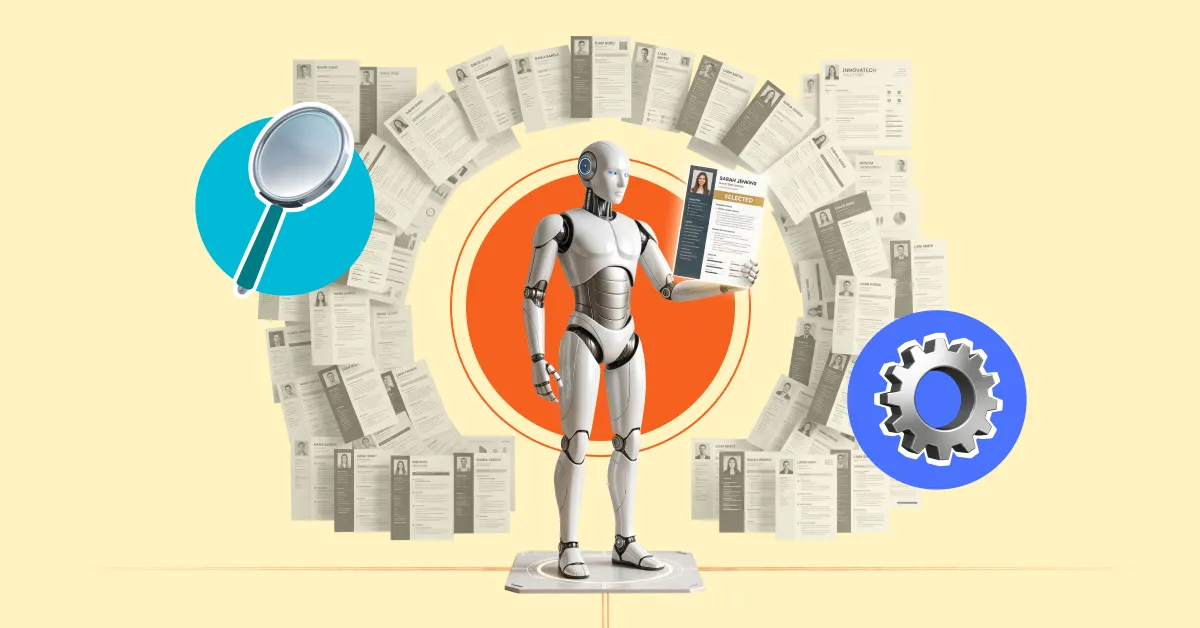
Initial resume screening is one of the most time-consuming stages of recruitment. Without automation, recruiters find it increasingly difficult to identify qualified candidates quickly and avoid losing top talent because of lengthy hiring processes.
A candidate screening AI agent automates this stage by analyzing resumes, evaluating candidates against job requirements, ranking applicants, generating profile summaries, and suggesting interview questions.
Business beenfits:
When organizations recruit for multiple positions simultaneously, preparing for interviews becomes increasingly time-consuming. Each role requires different evaluation criteria, interview scenarios, and sets of questions.
An AI agent analyzes both the job description and the candidate's resume, creates a structured interview plan, suggests relevant questions, and helps interviewers focus on the competencies that matter most for the role.
Business beenfits:
In most organizations, employee data is scattered across multiple systems, including HRM platforms, learning management systems (LMS), performance management tools, and employee engagement surveys. As a result, HR teams spend significant time gathering information and preparing reports.
An AI agent for HR analytics consolidates data from multiple sources into a unified employee profile, enabling HR teams and managers to analyze performance, competency development, employee engagement, and other key workforce metrics more quickly.
Business benefits:
HR processes involve handling large volumes of documents, including employment contracts, applications, certificates, and supporting documentation. Reviewing these documents and manually entering data into business systems is both time-consuming and prone to errors.
An AI-powered document verification solution automatically extracts information from scanned documents, PDFs, photographs, and other file formats, validates the data, and transfers it to corporate systems for further processing.
Business benefits:
Maintaining workplace safety across large manufacturing facilities is challenging when done manually. Even a single safety violation can lead not only to employee injuries but also to production downtime, regulatory fines, and additional business costs.
AI-powered computer vision solutions analyze video feeds from surveillance cameras and automatically detect safety violations, such as missing personal protective equipment (PPE), unauthorized access to hazardous areas, and other potential risks.
Business benefits:
From recruitment and employee onboarding to HR analytics, knowledge management, and workplace safety, modern AI solutions automate tasks that previously required significant time and human effort.
As a result, HR teams gain more time to focus on talent management, strengthening company culture, and supporting strategic business initiatives. At the same time, organizations benefit from higher productivity, more scalable HR processes, and a stronger competitive position.
If you're looking to assess the potential of AI-powered automation in your HR processes, the SMART business team can help. We'll analyze your current workflows, identify the highest-value opportunities for AI implementation, and develop a practical roadmap for transformation.